
Showing posts with label India. Show all posts

Wednesday, November 28, 2007

The Complete Photos: India


We were in India for longer than any other country, so I presumed that we'd have more photos of it than any other country. But, it turned out that Vietnam is still the record holder for the most pictures. Still, I think we did a good job of recording our adventures in India: From the passes of the Himalayas to the The fortress at Bundi, its all there.

Oh, and the Taj Mahal.

RTW: India

Wednesday, July 11, 2007

Food Around the World: India


It's time again for the travel-food collaboration with my friend, Jody, of eddybles. You can learn more about my food adventures and observations during our 34 days in India, and you can find Jody's delicious recipes inspired by these food forays, including Tibetan momos, sweet pea pistachio cakes and, in homage to my favorite dessert/beverage in all of India, a saffron lassi by visiting here. Enjoy!

One step forward, two steps back... (Revised)


First off, let me say how difficult it is to find a good internet cafe in South Africa. Like both New Zealand and Tasmania, I think that the general assumption is that people have access to the internet at their home and, as a result, public internet access isn't the industry that it is in developing nations where people can't afford to buy their own computer.

The side effect of that is that Sarah and I probably won't be able to post as often here. And, when we do, we'll be rushing to get the blog up-to-date. That said, let's get you all up-to-date:

The last couple of days in India and our arrival in South Africa were marked by a series of lows and highs. No sooner would we have something good happen to us, then life would throw us another curveball we had to work out. Day after day, I found myself thinking "one step forward, two steps back."

First off, it has to be said that neither Sarah nor I were particularly excited to go back to Dehli. Our first visit there had been marked by confusion, frustration and we had the spectre of the Travel Agency hanging over our head. We knew that we'd have to visit them, if we were going to get our money back; but we also feared that it would become a battle to get it back. In addition, we had a number of small errands to run and some things to take care of before we departed India for South Africa. Namely, we needed to confirm our plane tickets with Gulf Air.

When we got to Dehli, we hired a confused auto-rickshaw with (what appeared to be) a broken hip. And, after shuttering around downtown in his jalopy, we finally stumbled across our guesthouse (1 Step Forward). Unfortunately, it turned out to be a cement cell with barely functioning plumbing (1 Step Back), but that wasn't a huge deal because it was close to the Gulf Air office...

...or, at least it was supposed to be. It turned out that Gulf Air's office had moved around to the other side of Connaught Place, the neighborhood we were staying in (1 Step Back). Roughly one sweaty hour later, we arrived at their new office. Unfortunately, because it took us so long to find the office, they were closing right as we arrived (1 Step Back). Furthermore, after talking to a representative breifly, it turned out that Gulf Air no longer flew to South Africa (1 Step Back). Finally, since they were closing and since the guy was sort of a jerk, he told us we would have to come back on Monday (the day we were set to depart)if we were going to get things figured out (1 Large Step Back).

At this point, Sarah and I were really frustrated. So, we decided it was a good time to visit the Travel Agency. We figured we could vent our anger at them, and maybe it would help us get our money back. As we stormed across Connaught Place, various revenge style scenarios and macho phrases rolled through my head. I was ready to kick-ass.

Unfortunately... or rather, fortunately, the people at the Travel Agency were really cooperative and downright nice. It turned out that the agent who had booked our trip and then dropped the ball on actually making arrangement for it had been fired. In addition, the father who ran the Agency seemed genuinely repentful. After apologizing repeatedly and asking us how our trip went, he dutifully counted out the money he returned to us. Then, shaking our hands, he said that if there was anything he could do in the future to make amends, he would be happy to. (As you can imagine this was 1 Large Step Forward)

After that amazingly pleasant surprise, Sarah and I decided to treat ourselves to McDonalds (this was, believe it or not, 1 Step Forward). There are only a couple of McDonalds in Dehli, and they're worth a visit if your an American tourist. Unlike in the States, where it is seen as a source of cheap and unhealthy food, Indian's see McDonald's as a novelty and a luxury. This is reflected in the fact that there is a security guard at the front door, and the place is almost universally packed with people. In addition, the menu proves to be entertaining since India doesn't serve beef or pork. Instead, you have a few chicken items and an array of vegitarian burgers. Sarah and I each ended up getting a Maharaja Burger (basically a curry chicken Big Mac) and a strawberry shake.

After that, we decided to treat ourselves to a Bollywood movie experience, and bought tickets to see Awarapan. We had expected to be jammed into a hot, dirty theatre with hundreds of shouting Indians, but the theatre ended up being nicer than most cinemas in the States. We had assigned seats that reclined, working Air Conditioning and the theatre was only about half-full. We quickly realized that the cinema we were in was sort of the Dehli equivalent of Cinerama, but it's movies were a bit more art-house (or at least as Art House as Bollywood gets). Awarapan itself turned out to a great movie... or at least what we understood of it, since it was in Hindi with no subtitles. At first I thought it was basically the Indian version of Micheal Mann's Miami vice, but with more singing... except there was only one real Bollywood style song and dance number. The rest of the music was actually really cool Indian-fusion music set to montage scenes that were used to break up the gunfire and kissing-free love story.

Though I'm still a little confused on the details of the storyline, I will say that I enjoyed it a lot (1 Step Forward) and still find myself thinking about it.

That was all on Saturday, and since we basically had nothing to do until monday morning, Sunday ended up being a bit of a wash. We did some shopping (including buying an MP3 disk of music, featuring the Awarapan soundtrack) and arranged a hostel for Johannesburg. Johannesburg has a bit of a reputation as a rough town, and Sarah and I didn't want to arrive in it late at night with no place to stay. Arranging the room turned out to be a bit of a trick though. The power in Dehli is a bit fickle, and every time we tried to swing by an internet cafe or call center, things seemed to be on the fritz (1 Step Back). Still, eventually, we were able to do an internet search and find some names and numbers of hostels in Jo-burg to call. Unfortunately, the first one we contact was full (1 Step Back), but luckily the second one had a room for us (1 Step Forward). So, having booked a room we celebrated with a fancy dinner at the Zaffron, a nice restaurant the travel agency had taken us to our first time in Dehli (1 Step Forward).

The next morning we awoke early to go do battle with Gulf Air. Luckily, when we got there, the lady that helped us that time was as cooperative as the Travel Agency had been (1 Step Forward). She arranged us a new flight. It meant that we had to leave the following morning, as opposed to Monday evening (tiny step back), but at least we knew we'd be airborne soon.

Tired of our run down guesthouse, we decided to switch to another one (1 Step Forward)... one with A/C and a shower that didn't bonk your head every time you used to the sink.

After that, since we had the afternoon to spare, we did a little shopping for trinkets before getting to bed early.

The next morning, we awoke early (like, 2:45AM early), and caught our flight. From Delhi, we'd fly to Bahrain where we'd change planes and fly to Dubai. We had a short layover in Dubai, and from there flew to Johannesburg. The plane leaving Delhi was late, so when we arrived in Bahrain we were literally sprinting to catch our plane. But, safetly on it, we quickly found ourselves in Dubai.

That's where things we bad, for me at least. It all started with four simple words from Sarah: "Tyler, where's your hat?" And, like that, I realized that my white hat was missing. Thinking hard, we quickly realized that I had left it in the restaurant where we had eaten dinner our final night in Delhi. I was devastated (1 Big Step Back). Now, losing a hat might seem like a little thing, but it was a big thing for me. After Sarah, that hat had become my constant companion and best friend on the trip. And, poor Sarah was stuck consoling me in the Dubai airport as I moped and mentally abused myself. For a bit, we thought we might be able to contact the restaurant and have it mailed to us, but that option would later prove to be unrealistic. My hat was gone, and I was in a mood.

The next major set back came when we reached Johannesburg. Because our connection had been so tight in Bahrain, our luggage didn't arrive in Jo-burg with us (1 Step Back). To make things worse, South Africa was in the middle of a cold snap... and I was just wearing a T-shirt, jeans and sandals (1 Step Back). So very, very cold.

Emirates Airlines, who we'd been transfered to from Gulf Air, gave us a case number, said they'd be in touch and sent us out into the cold. The following morning, we awoke in our guesthouse (the nice, yet drafty Backpackers Ritz), and started harassing Emirates about our bags. They still had no idea where it was, but told us it was ok to buy some "basic needs" and they'd pay us back. Sarah mentioned to them that I was only wearing a T-shirt and sandals, and they said shoes and a sweater would count as a basic need.

So, we went shopping (1 Step Forward). I never found some good cheap shoes, but picked up a sweat shirt (or "jumper" as they are called here) and we also got a change of underwear, socks, T-shirts and some toiletries. Also, since we had no idea when they'd find our luggage, we decided to book a safari for the following Saturday... since who needs clothes for a safari, right?

That night, we went to bed still not knowing where in the world our luggage was.

The following morning though, we had some hope. Sarah got on the phone again, and this time someone from Emarites confirmed that they'd found our bags and would be arriving that afternoon (1 Step Forward). So, with that good news, we decided to tour Soweto, or the South West Township, but I'll talk about that more below.

Needless to say, even though they didn't arrive until late that night, we were finally reunited with our bags that night (1 Step Forward).

...Now, if we can just get Emarites to refund us for the money we spent on the close (1 Step Back).

A few quick observations about South Africa

Since we are in South Africa, I feel obligated to address the giant elephant sitting in the room. And, I'm not talking about the elephants we saw on safari, i'm talking about the shadow that lurked over this country for many years: Apartheid. Racism. Race.

So, let me just tackle it head on and make one observation: The white people here are really white. I mean, their complexion is so pale and their hair so blond that they make Sarah look like she's from the Mediterranean. In addition, they are very... well... preppy. The standard male outfit is a sweater over a white dress shirt, which is in-turn tucked into a pair of Dockers. The women are fans of pleated skirts and sensible shoes.

That said, everyone we've met has been almost unnaturally pleasant in a salty, off-color sort of way. The men who ran our guesthouse in Jo-burg (also affectionately called "Jozi") were the types of people who casually wove the F-word into every sentence the same way people on the West Coast use the word "like."

And what about the blacks? The other 80% of the South African population?

Well, as a white tourist, its a little more difficult to meet and get to know them. The closest analogy I can make would be to Latinos in LA. On an average day, you see black Africans but generally working in service positions - waiters, cooks, parking lot attendants, etc. There is a general sense that things have improved since the Apartheid, but for the most part whites and blacks seem to live in seperate, parrallel worlds.

Jo'Burg is a good example of the surreal, unofficial division that exists in South Africa. Basically, downtown Johannesburg is considered unsafe for tourists. There are no guesthouses in the downtown, and if a tourist wants to go there (to, for example, go to the museum) they hire a cab that takes them directly to where they are going and will bring them straight back. All the guesthouses are in the suburbs.

The suburbs of Johannesburg look a lot like Seattle's Eastside... except with more walls, razor-wire and electric fences. This is where the whites live, and is generally considered to be safe. For Sarah and I, coming from countries like India and Vietnam, the suburbs seemed amazingly similar to the States. But, the more you are there, the more you notice the weird added layers of security. At first they seem peaceful but there is a definite underlying layer of tension there.

Out beyond the suburbs you have the Townships, or which Soweto is the most famous. This is where the other 80% of the population lives. The townships were originally created during the Apartheid. At the time, the whites living in Johannesburg have a large number of blacks working for them, but didn't want blacks living around them. So, the government built the townships to provide the black servants a place to live.

Basically, the townships are made up of thousands of identical houses built by the government for the blacks. But, since at the time blacks were forbidden from owning land, they were rented out to them. They would then be buses and trained into Johannesburg each day to work. After the end of the apartheid, ownership of the houses was transfered to the families who lived in them.

(Note: I might have some facts messed up or generalized, but I'm just trying to give you a rough idea.)

On our second day in johannesburg, Sarah and I decided to do a tour of Soweto (or the South West Townships). Now, taking a tour to see Soweto (or any of the other townships) might seem a little, well, off. Sort of like turning Soweto into a Zoo. But, the tour was owned and run by a man who grew up in Soweto and still lived there, so at least we were effectively supporting the communitee. Plus, honestly, it proved to be one of the only ways to see more of South Africa than the white suburbia we'd seen up until that point.

We weren't sure what we expected, but we were also sure that it was different than what we expected. I tihnk we had presumed that it would be depressing and difficult. But, honestly, the main feeling we came away with was one of hope. The guide pointed out both houses that reflected the original living conditions in the township, but also pointed out a number of houses that had been rebuilt and built up since the end of the Apartheid. He also pointed out how the roads had been paved, and electricity and water had been put in. While there was still alot of poverty, there was also signs of improvement... which when you compared it with some of the more desolate slums we saw in India, was downright inspiring.

In addition, the Soweto tour took us by Nelson Mandela's old house, Archbishop Desmond Tutu's current house and a small musuem chronically student protests in the area.

The following day, we went to the Apartheid museum, which was a truly powerful experience. And, like Soweto, there was an undercurrent of hope and improvement. The museum did a good job of laying out the history and injustices of the Apartheid, but also left you realizing how much things have improved and how much disaster had been averted.

Anyhow, I'll end this entry now. I have to admit that I'm still trying to work out how I feel about a lot of the stuff I've seen and experienced. And, I'm sure I will be for a while. But, I do know that South Africa, like many of the other countries we've visited, is leaving me with a lot to think about.

Saturday, June 30, 2007

Taj, trains and the trouble with auto-rickshaws


The Taj Mahal

Ever since we started planning our big trip, we've sort of considered India to be the Main Event. That's not to say that India would be the end of our trip, but instead it would be the part of the trip that would challenge us the most and also hopefully be the most fulfilling. And, if India was the Main Event, then the Taj Mahal would basically serve as the Grand Finale of the Main Event. To this end, Sarah and I had deliberately put off going to Agra until the end of our India leg. That way, if nothing else, we knew we'd be ending this leg of our journey on a high note.

The first time we caught a glimpse of the Taj was walking across the bridge entrance of the Agra Fort. I just happened to glance to my left, and noticed a number of white onion-shaped objects rising above the distant tree.

"Oooh, oooh, Sarah! Come look! See what I see!"

A short time later, as we continued to explore the Fort, we found ourselves on a massive deck that looked across the river to the Taj Mahal. It's amazing really, on this trip we've been fortunate enough to see a number of world famous sites. Macchu Pichu. Easter Island. Angkor Wat. So, you'd think that at this point, we'd be getting a bit numb to these sort of experiences. But, those first glipses of the Taj still stunned me as I looked across the river at it - slightly blue in the mist and atmosphere, looking more like a matte-painting than a work of architecture.

At this point, we've seen it, but it still doesn't seem real.

But, that's not to take away from the Fort itself. Agra Fort is one of those locations that could otherwise captivate you... its just that it has the misfortune of sitting in the (nearly literal) shadow of the Taj Mahal. With its massive walls, ornate marble-work and expansive courtyards, it took Sarah and I the better part of our first day in Agra to explore all of it.

A courtyard in the Fort. The size and detail of the place is amazing.
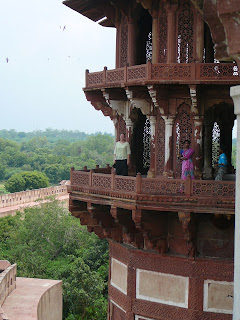
Sarah poses on a turret in the fort. The small kids next to her would later ask to have their picture taken with her.

Later that day though, our auto-rickshaw driver (more on him below) took us to a spot on the far side of the river to look across at the Taj from there.

As we approached the river, a group of small children approached us (one carrying a baby goat), and began asking us our names and where we are from. Having been in India for a month now, Sarah and I are used to this. Not just children, but adults too, will approach us and inevitably hit us with the same flurry of questions:

What is your name? What is your friends name? Where are you from? What is your occupation? How long have you been in India? How to do you like it here?

It is almost always the exact same set of questions. And, after anwsering them a dozen times a day for the last 30 days, let's just say that they get a little tedious. So, Sarah and I have come up with aliases. I'm now Rupert, and she is Belinda. We're from Sweden. And I'm a secret agent.

Oddly, these anwsers elicit the exact same responses that we get when we use our actual, factual information. So apparently, in India, being "someone who works on the Internet" is just as maginally interesting as being "a secret agent, like James Bond."

Having introduced ourselves (or at least introduce Rupert and Belinda) to the children, and assuring them that we had no intention of paying them for ther pictures, the children (and their goat) ran off to find other tourists to quiz. Letting us get back to staring at the Taj Mahal.

Now, we've run into several people who have been to Agra and only looked at the Taj from the view across the river, and said that it was all they needed to do. Their argument is that the entrance cost to the Taj itself is too high. And, while I agree 750 Rupees (about $18 US) is a lot, comparatively; Sarah and I also knew that we had to go in. I mean, we've payed thousands of dollars to get to this point. To stop and only see it from across the river seemed a little goofy. Like climbing Everest, stopping 100 meters shy of the summitt, and going "y'know, the views good enough from here, I'm going back down."

So, the next day, we got up bright and early (as I've mentioned before, that's become a bit fo a challenge for us) and made our way to the entrance of the Taj Mahal. After paying the entrance fee (and checking our tiny, tiny camera tripod at the door, because -rather randomly- they aren't permitted inside), we made our way into the Taj Mahal complex.

Now, I've noted before that its easier to write complains than it is to write praise, so instead of straining to find interesting adjectives that mean "wonderous" I'll just post a few photos and make a few points.

A close up of the level of detail on the outside. Since most photos are from farther away, you don't realize how much color and detail is featured on the marble work.

First off, if you do go, go in the morning. When we first arrived, the crowds were reasonable. But, as we prepared to leave a couple hours later, the crowds were beginning to swell. Luckily, the complex is large enough and the architecture is grand enough that you tend to not notice the sunburnt masses swirling around you, but still.

One of several "Look! We were really there!" photos we took.

Also, the sound inside the Taj Mahal is incredible. Its something we've never heard anyone talk about before, but its truly unique sounding. The main tomb portion of the Taj has (as you might suspect) a giant dome, marble ceiling. Inside, everyone does their best to be quiet, but the acoustics are such that every little whisper and shuffle travels to the top and echos around in such as way that the entire room is filled with this low, hollow, roaring groan. It's a dry, omnipresent, yet oddly-peaceful sound ...and its amazing.

The Trains of India
So, we took the train from Bundi to Agra. As Sarah mentioned in another entry, we've become accustom to riding buses in India, but at the same time, we realized that no trip through India is complete without a train ride. So, we scheduled a ride on an overnight train from Bundi to Agra.

First off, the train tickets in India are basically useless. They contain a bunch of information, but don't contain any information you might actually need. Like, the train number. Or what car your on. Or what platform you need to catch them at. In addition, the station generally has no one available to help you sort out these facts, so you are basically left in the position of hoping on a train and hoping that its your train. Also, there appears to be no one actually checking tickets on the train, which means you still aren't sure your on the right train when it pulls away from the station... and leaves you wondering why you even spent the money on the useless ticket in the first place.

Once on the train, we found what we thought were our seats, but they were filled with two sleeping elderly men, so we just grabbed other seats at rondom. This worked fine, until we reached the next major station, and people started demanding their seats (which we'd inadvertently taken). At this point, some nice fellow -who may or may not have been a station attendant- took pity in us and directed us to another random car and told us our assigned seat numbers (which seemed to have no relationship to the seat numbers listed on the tickets).

The train then started moving again, but started heading back the way we came. Which caused a moment of panic until I asked someone who assured me that the train was going to Agra... and not back to Bundi.

We had tickets for "sleeper" seats, which we presumed meant that we would be sharing a bunk-bed cabin with two other people. But, in reality, it meant that we were each sharing a bench with two other people. When it came time to sleep, these benches converted into three-bed-high bunkbeds. The main problem with this was that it allowed some of the people around us to play the game "Watch the Sleeping Tourists." We've grown used to the fact that everywhere we go people are staring at us... still, its a little unsettling to have people watch you try to fall to sleep.

The train ride from Bundi to Agra did nothing to prepare us for our second train ride though: Agra to Dehli.

The second class train tickets we got for this ride claimed that the trani would be "Super Fast™" ...but failed to mention that it would also be "Super Crowded™." Crowded train rides in India are one of those things that travellers hear horror stories about. But, which nothing can prepare you for the reality of. So, let me break it down for you.

First off, the train arrive (or what you presume is your train) and a crowd starts to mill around outside the train car doors. When the doors open, you realize that the car is already full of people, but that doesn't make any difference to the crowd outside which imediately begins pressing itself into the car. Like our bus ride from Pushkar to Ajmer, just getting on the train is a battle. The melee is not disimilar to a group of sugar-charged children bum-rushing a broken pinata.

Like Sarah mentioned in her description of boarding the bus, the main tactic involves merciless pressing yourself forward, until you reach the point of no return that suddenly the people behind you start pushing you into the train car.

Once inside, Sarah and I have a unique problem, in that we both have massive bags. Inside the train, there is barely enough room left to stand (and no apparent room for luggage), so we both slid our bags off and planned on sitting on them. At the same time, we've noticed that there is one large Alpha-Male type guy who is reclining on one of the top bunks, taking the whole thing for himself. As the crowd continues to press in around us, Sarah and I begin flashing him evil looks until suddenly he sits up and invites us to sit next to him. We aren't sure if its because of our Mean Faces™ or because he's decided it would be fun to sit next to tourists, but we quickly take him up on his offer regardless.

Now, the train car is divided into a number of subsections. Each subsection is made up of a top and bottom bunk bench, facing another set of benches. On one top bunk is me, Sarah, the Alpha-Male and a middle aged woman (who climbs on at the next stop and proceeds to take the majority of the bench for herself). Across from us is (what I presume is) train attendant, what I guessed was his brother, two other men and a small girl who is so squeezed in that we can hardless see her head peaking out over their shoulders. Most of us have taken our shoes and sandals off and have placed them on the fans on the ceiling above us, so that we don't accidently kick those elow us with them. Below us is a half dozen other people, and across from them another half dozen. Between those people there are three or four young boys who are standing, and catching my Rupees that keep falling out of my pocket onto their heads.

It's a tight fit to say the least. And, after three or four hours squished into those positions, we are happy to be in Agra... and off the train.

Which is where we meet our auto-rickshaw driver.

The trouble with auto-rickshaw drivers
I would say that a good 60% of the problems we've had in India stem from our dealings with auto-rickshaw drivers. They're obnoxious... really, they are. As I think I mentioned elsewhere, dealing with auto-rickshaw drivers is like being stuck in a bad relationship with a really, really needy and clingy partner. I'm going to describe how our "relationship" with our rickshaw driver in Agra went. It is by no means atypical of what we've experienced with other drivers.

As we exited the station, we are approached by a middle aged man. "Need rickshaw driver?" He asks.

"Yes, actually. Do you know the Tourist Rest House?"

Surprisingly he anwsers "yes."

"How much to get us there?"

"30 Rupees." Which is reasonable. So, we accept. He leads us out to a rickshaw which -like many we've ridden on- barely starts. There's another guy who is actually driving it, and his job seems to be to sit and talk to us while we are riding.

"If you like, we can come back in a couple hours. After you shower, rest and eat, and then take you out to the sites. Taj Mahal is closed today. But we take you to Fort. To Baby Taj. To other tombs. Take you to river. You can see Taj from across."

"How much?"

"200 Rupees. It is slow season, so we give you good deal."

Arriving at the guesthouse, I finalize plans with him.

"So, for 200 Rupees, you'll take us to the sights."

"Yes."

"And we choose where to go. No shops, right?"

Slight smile. "As you wish."

"OK, pick us up at 1pm."

So, 1pm comes, and the two men are waiting outside the hotel with their rickshaw. At first, things go well. They take us to the Fort, which is amazing. And the "Baby Taj," which would have been amazing if we weren't hounded by a flock of children shouting "take our picture one rupee!" Then another tomb, befoe eventually taking us to the river to see the Taj.

The "Baby Taj." So named because it looks like the Taj Mahal... except smaller. It actually pre-dates the Taj Mahal.

But, slowly, he starts mentioning taking us to "factories," which is rickshaw driver shorthand for "shops."

"Maybe we take you to factory to see how marble is made. And one for rugs. Very interesting."

"No, we don't want to go to any shops."

"But, these are more like workshops. See how they are made." Generally, in these workshops, a disinterested employee gives a 3 minute demonstration on how to do something, before you spend the next hour or so trying to convince them you have no interest in buying their item.

"No. No shops. No workshops. We don't want to buy."

"But, it is interesting. Here is only place in India where you can see this sort of marble work done. And rugs made..."

"No. We've already seen rugs made."

"But, is interesting. It is experience..." Rickshaw drivers like to try to make going to shops seem like an experience on par with seeing temples or forts. "Maybe you take picture."

"No. They'll try to make us buy something."

"No pressure to buy. It will be very quick. You just take picture and then leave. You will have picture for memory."

"No we don't want a picture. And we don't want to see how marble is made. Or rugs are made."

This sent him into a sullen pouting session for the next couple of sites. After looking at the river and Taj, Sarah and I were ready to go home.

"It is still early, maybe go to a workshop very quickly."

"No. We are tired and want to just go back to our room. So, take us home, and we can pay you for the day."

"But, you must undestand. 200 Rupees is not very much money. That barely pays for the driver. And his gas." He says gesturing to the always silent driver. "We need money to survive. Shops will give us money to bring you. Comission."

"We know how it works. I'm sorry, but no. You agree that the amount was 200 Rupees, and no shops. You said 'as you wish.' If that wasn't enough money, you should have said. We would have been willing to pay more, if you had requested more. We would have paid more, to not go to shops. If you had been honest. But you chose to lie. That's not a good way to do business. So, no."

OK, no I might seem like a bit of a moralizing jerk here. But, still. I mean, they do this to us every time. A short while later...

"So, tomorrow, I pick you up at guesthouse and take you to Taj. Maybe afterward, we go to shop."

"No. In fact, don't plan on picking us up tomorrow. We will make other arrangement."

More pouting.

Then, as we get off the rickshaw I turn to pay him. I hand him 300 Rupees. He looks at it.

"It was 200 Rupees for tour. And 30 for ride from train station. That money is for driver. What about for me?" He seems to be ignoring the additional 70 Rupees.

"What did you even do?!" We storm off flabbergasted. That evening, we had a pleasant meal on a rooftop restaurant overlooking the Taj. Around us, hundreds of people mysteriously were flying kites, the city sky filled with them. Sadly, as Sarah can tell you, all I could do was mumble and grumble about rickshaw drivers.

Our view that evening for dinner (notice the kite in the foreground)...

...but here's the type of face Sarah had to see me make.

Now, go back and read the first part of my entry. Because the Taj Mahal was really fantastic. And, it'll help end this blog entry on a good note.

We also have some good news and stories involving Delhi (and one piece of bad news)... but I'll save those fo a future entry. This ones run too long.

Scenes of Bundi


We stayed five nights in Bundi. Like many legs of our trip so far, we often end up with a little more time than we'd like at once place near the end. We thought we should leave Pushkar, we didn't want more time than necessary for Agra or New Delhi, and there really wasn't anything else en route to see, so Bundi it was. Five days was a little long, so we spent a fair amount of time trying to stay cool in our room, a day's adventure being a trip to the bank or a gander at some of the water tanks throughout the city. Here's a little pictoral review of some of our time.

Bundi's Baoris

As Tyler had mentioned, Bundi was filled with baoris, or water tanks, that were used for ceremonial purposes in the late 17th/early 18th century. The most impressive was the Ranij-ki-Baori, or Queen's Baori that was only 20 meters from the main market area. The tank was built deep into the ground, with beautiful carvings on the walls and pillars connected with carved elephants and sinuous arches. The scale was impressive. It must have been almost 50 meters deep into the ground.

We saw others around town, some that were almost equally impressive but not as well-tended. Most were overgrown and being used for more domestic purposes, such as drying cow dung. One closest to the market that we stumbled upon seemed to have been re-purposed as a garbage pit.


Queens bath--you can get a sense of the scale by seeing Tyler down at the bottom


Graceful pillars and sinuous arches at the entrance


Another baori, or water tank, demonstrating why they are sometimes referred to as "step wells." Note the power station built right next to it.


Memories of Cambodia

I'm sure this is true of more of Hindu India (outside of the predominately Buddhist and Muslim areas we stayed in), but I was pleasantly surprised to see temples and architecture styles similar to that of the temples we saw in Siem Reap, Cambodia. Angkor-esque towers rose randomly throughout the city, which was filled with an impressive number of revered icons and temples. It makes sense, since the Angkor temples were built by Hindus, but it was still a fun connection to make from different locations of our journey.


Angkor-esque temple in Bundi


Angkor-esque sculpture on a cenotaph, or tomb


Bundi Market and Street Scenes

Almost every day, for one reason or another, Tyler and I would have to run the gauntlet that was walking down the main drag and through the market of Bundi. It always exhausted us, dodging bikes and motorbikes and cows and manure and people, being constantly barraged by the same conversation ("Hello, what's your name? What country?") and attempts to sell us something, anything all the while sweating profusely. I didn't get many photos there--having the camera out meant having lots of requests of "one photo?!", in other words, rupees for the photographed--but here are a few favorites.


Bundi milkmen's rides. The milkmen came in from the villages and then rode around town on motorbikes with the brass urns, from which they would ladle out milk for businesses and households.


Chili seller in the market


Sewing machine repair man. In India, you see some modern things, but you also see items, such as sewing machines and bikes, that have been repaired and held together for years (probably decades in many cases)


Mehndi

While at our guesthouse, our host (whose name is actually "Sashi" we finally confirmed) offered to do henna, or mehndi, for me. Basically, it's a temporary tattoo of sorts made of a paste of henna that is piped onto the skin and left for six hours to leave behind a reddish-brown design. Henna is common throughout India, but the design varies by region. It's supposed to last for 10-15 days, but after about five days much of mine has faded considerably.


Mehndi-ed hand with the paste still on (sorry it's sideways!). You can also see I've got on a fancy stick-on bindi from the mother of the guesthouse to complete my Indian look!


Mehndi-ed feet the next day


Overall, there were good and bad things about staying in one place so long. It was a small enough town that we had mini-relationships (the guy we bought water from, the samosa guy, the internet guy, the place to burn CDs), but we did start getting a little antsy. Without that many sites, things to do, or much of a purpose after about three days we were a bit listless. Here's a nice shot Tyler got of the view coming into town when he went to buy our train tickets to Agra:


The view of Bundi from the main road

Monday, June 25, 2007

Joining the Parihar Guesthouse Family


In each country Tyler and I have travelled in, we eventually hone in on the type of place we'll end up seeking out for lodging. In South America, it was the family-run two-star hotel. In New Zealand, holiday parks. In India, we're finding we're happiest at small, family-run, slightly eccentric guest houses. There aren't necessarily a lot of frills (like Western toilets and hot water), but it's a little less anonymous--and more interesting. So when we landed in Bundi we checked out about four places before we found the right one for our stay here.

Parihar Guesthouse is run by a set of five siblings, but mostly by the second oldest outgoing sister and the second youngest brother. When we looked at the room and then saw the amazing view from the rooftop (to which we have direct access off our room), they mentioned that we should feel at home, we were like family.

Now, we've heard that before in India (the travel agency, for maybe the worst example), so I took it with a grain of salt. But over dinner that evening, Sheesha, the sister, invited us to join the family celebration the next night for her nephew's fifth birthday. Just a small party, she said, 40 to 50 guests, with traditional Rajasthani food. We were delighted.

From early in the morning, we heard the household bustling about in preparation. After climbing up the hills to see the palace and fort, we came back to shower and dress in our best travelling clothes. Lucky for me, I got to wear my new Tibetan shirt from McLeod Ganj and feel like I almost evened out with the fancily sari-ed women attending the party.

The party itself was an interesting cultural experience. The first event is the cake cutting. For 40-50 people, they had a cake that was about six inches square. After the birthday boy cut into it and blew out a candle (confusingly, the number "4"), the family then proceeded to cut it into the smallest slivers that would still have some structural integrity and then passed those out to the guests. At the same time, the decorative balloons strung from the ceiling were all popped in celebratory bursts as the guests sang "Happy birthday to you, happy birthday to you." Like the American version, but just the one phrase, about three times. By the time I heard what it was and was ready to join in, the singing was over.

Then came the food--what I had been most looking forward to. The family had specially brought in some people to cook for about five hours during the day to prepare the feast. In the traditional way, people sat on the floor, with leaf plates as family members served them. First the men, then a motley lot of some women, children, and Tyler and I with one of the brothers. Then more men. Then the last service for the remaining women.


Our turn at dinner!

The food was delicious and very filling. Fortunately because of the group seating, I could cheat and see what people around me did for eating. There was Rajasthani bread, which you use to eat the two main dishes served in small bowls--dal (lentils) and a spicy curry dish with what initially looked like sausages but was some sort of chickpea (chana) conconction. There was also pulao, or a rice pilaf with peas, cashews and lemon. I ate this plain, but you could pour one of the other dishes on it to create a thick stew-y mixture you could eat with your hands. There was also a tomato garlic chutney to eat with the bread that Tyler was really fond of. Oh, and dessert. Rajasthani desserts seem to be made of flour and butter and sugar--a super-sweet, crumbly dessert with some pistachios and maybe coconut on top. As I pushed up off the floor, I was groaning and full.


Dinner plate: (starting at 12 o'clock and going counter clockwise) dal, chickpea dish, chutney, pulao, bread, lemon wedge, and dessert.

There was also some pomp and circumstance because it turns out Sheesha is getting married in November (bigger party, five days with about 5,000 guests), and her future in-laws attended. It was clear that it would take a long time to learn the local culture--who gets how much respect, in what order people are greeted and eat, where and who you hang out with while the food is served to others, etc. But we were treated as honored guests, almost so much that it was a little embarassing. We wanted to just blend in with the crowd, but everyone was always making sure we got cake, drinks, if we wanted food early or at the table instead of the floor, and we monopolized one brother's attention for the evening. I think he was charged with talking to us since most the guests didn't speak English. Fortunately, we felt less like slightly out-of-place guests and more helpful after we ate and became the "official photographers" of the event, taking group shots as requested as no one else had a camera.


Hosts in their finest: (from left to right) oldest sister and mother of the birthday boy, second youngest brother, future mother-in-law, youngest brother, Tyler, (I think future father-in-law behind), third oldest brother, friend of Sheesha, Sheesha (second oldest daughter)

All in all, a great evening. And we did feel like family, at least in a family-you-almost-never-see-that-no-one-really-knows-what-to-say-to-but-welcome-nonetheless kind of way.

Sunday, June 24, 2007

The work of goblins...


Jeypore Palace may be called the Versailles of India; Udaipur's House of State is dwarfed by the hills round it and the spread of the Pichola Lake; Jodhpur's House of strife, gray towers on red rock, is the work of giants, but the Palace of Bundi, even in broad daylight, is such a palace as men build for themselves in uneasy dreams-- the work of goblins rather than of men.
--Sir Rudyard Kipling

Like Pablo Neruda, Rudyard Kipling is a famous literary figure who I know nothing about, but whose path Sarah and I have now crossed while on our trip. And, while sipping our post-dinner beer on the roof top of our guesthouse and staring at the Palace of Bundi bathed in surreal orange light, it was not difficult to see why Kipling would suggest that it's architects had been something other than man.

The Palace of Bundi at night, or Hall of the Mountain King? You make the call.

The Palace of Bundi is the sort of fantastical palace cum fort that when you sit under it and look up, you can't help but think "why isn't this the most famous place in the world?" But, since Rajasthan seems to have more palaces and forts than it knows what to do with, the town of Bundi remains relatively undiscovered by the tourist crowds... especially in the sweltering hot days of June.

It was the sweltering hot weather, in fact, that kept us from waking up early and exploring the Palace which sat mere blocks from our guesthouse. We've noticed something about our stay in Rajasthan so far, every morning we say "let's get up early, before it gets hot, and do some sight seeing." Then, the next morning comes, my alarm goes off, and we just go on sleeping. I think the main problem is that it never cools off. It stays hot straight through the night. So, when it comes time to wake up, Sarah and I just find ourselves fitfully trying to sleep a little longer, under the delusion that the ancient fan creaking above us is doing anything to keep the furnace at bay.

Still, after waking, taking cold showers (another completely futile activity), and eating breakfast, we were on our way. The previous day, we'd befriended a man working at the corner shop and asked him to start putting bottled water in the freezer of his fridge for us (a trick we learned in Pushkar, to help keep it colder for longer). And, we were quite pleased to find out that he actually had. Greedily, we bought the water which (while not frozen) was blessedly cold.

Then we begin our hike up to the Palace. Surprisingly, unlike pretty much every other ancient architect we've encountered, the architects of the Palace didn't seem to be overly fond of stairs. Unfortunately, instead, they just made really steep stone-paved roads. By the time we reached the font gates, we had drank most of our water, and had worked up a good sweat.

The first portion of the Palace (we'd later learn) was the "Men's Section" where the Maharaja would live and see visiting diplomats and guests. It was filled with large courtyards, amazingly frescoed rooms (in the "Bundi Style") and small, ornately carved decks which looked out at the city spread below it.

The view from one of the balconies of the town of Bundi.

The next portion (slightly farther up the hill) was the Garden, or "women's section," where a kindly guard (or was it gardener?) showed us around, and explained some of the fresco's meaning. In addition, he showed us into several small chambers, with mirrored mosaics, that served the sleeping quarters for the Maharaja and his wife.

The peacceful garden in the Women's Section.

A fresco in the Bundi Style, from the "Women's Section." The fresco's in the Men's Section were hard to photograph because of the dim light (and the restriction on using a Flash) but were similar in style, if not content (the men's fresco's featured a lot more fighting).

Heading further up the hill, the road became rougher. It wound up past another view point to a series of smaller forts and "stepwells." Sarah and I remain a little foggy on the point of the stepwells. We do know that they became a bit of a status symbol for the elite, with each person trying to build larger and larger stepwells. Sarah mentioned that she thought she'd heard they were for catching extra rain water, in case of later droughts or sieges.

A view of the Palace from farther up the hill. Beyond it, you can see the man-made lake it looks out over.

A stepwell: Giant, staired pits in the ground, ending with a pool of water.

But, as we approached the upper level forts, we saw something else: Monkeys. In town, when we mentioned to people that we were going up to the Palace, most of them responded: "Ah! Very good! Just be sure to bring a stick to chase off the monkeys."

And now, at the top of the hill, we began to see them. The goblins from Kipling's quote. Making their way from a large tree and through a nearby gate. And, we had no stick. And the sticks lying on the ground around us were covered in fierce thorns.

So, instead, Sarah knelt and picked up a small rock, to throw in case they made trouble. Meanwhile, trying to be macho, I went around grabbing an armful of stones; presumably in case we were attacked by a small legion of monkeys. Carefully, we continued on.

As we picked our way around the walls and stepwells, we could see the monkeys peering down from their fort at us. And, as we made our way to a vantage point to try to get a view of the surrounding countryside, we noticed a large male monkey sitting in the shadows.

Faced with potential Death by Monkey-Business™ and with our reminaing water long since drank, we decided to retreat down the hill. At the base of the hill, our shopkeeper friend sold us another ice-cold bottle of water, along with a Fanta (which Sarah's brain is convinced is providing her with Vitamin C), and then made our way back to the safety of our guesthouse room and its over-worked fan.

As A Final Note: The town of Bundi still thinks that a dial-up modem connection is "State of the Art." As a result, it's physically painful to upload photos... so, if going forward, there are less photos in our entries: Blame Bundi.

Pushkar: Small but not Quiet


Yes, I'm back. Fortunately after only one day, lolling about and sweating in bed. Tyler and I have probably mentioned it was hot in Rajasthan. So hot that we just couldn't drink enough water to feel cool and sated. But apparently enough water that I threw my electrolytes out of whack while still getting dehydrated. Let's put it this way: it's not healthy to drink 2+ liters a day and still not go to the bathroom. So a packet of not-great-tasting rehydration salts later, and I am pretty much back to normal.

But Pushkar is not. While there aren't many tourists brave (or stupid) enough to face the heat, the town is anything but quiet. We actually would have liked to stay at least one more day. There were still a number of temples to explore, and we just liked the place. But our guesthouse owner (who we're still trying to figure out if she's French, Italian, or Swiss) let us know about some current events that led to a hastier than desired departure.

When we first arrived in Delhi, there was unrest in Rajasthan, the area we're in. Unrest as in policemen being killed, police stations being burnt down, roadblocks and tearing up railroad tracks. The best we could figure out about the situation when asking around had to do with the still existing caste system. There are a group of people in Rajasthan called Gujers. Apparently, they were tribal people outside of the government caste system and were quite well off. But times have changed and they want some of the protections and benefits of caste status. Like American affirmative action, government jobs are doled out in percentages to different groups, and the Gujers want a piece of the action. Ironically, this seems to mean being downgraded to a lower caste than they would be considered now. And the existing castes don't want to lose any of their benefits, so it's a difficult situation. The riots were called off when the government agreed to have talks about the Gujers status. And, apparently, those talks are happening today. In Pushkar. While we didn't see anything too out of the ordinary on our way out of town, 2500 policemen were being shipped in, and our guesthouse owner said she saw Gujers arrive with guns.

On top of that, this is the month for weddings, and Pushkar is a holy city that is apparently big for weddings. On one day, today--same as the government-Gujer talks--two different groups from Rajasthan come and have a huge joint wedding with 110 couples getting married, each individual bringing about 30-50 family members. Oh, and the two groups traditionally don't get on that well either.

So staying in Pushkar meant seeing through government talks, mass weddings, and possible political and tribal unrest. We decided to move on.

Oh--and when I was sick and thought about talking to a doctor, I couldn't see the nearby doctor because he was busy treating a guy who'd been gored by a bull in the market that morning. The local cows seemed a lot less docile the rest of that day. (And I'm still curious what they do with a bull that's gored someone. They can't kill it--cows are holy--but it can't be safe to leave them around town. We still don't know the answer.....)

So after some chai and admiring the menagerie of our guesthouse (tortoise, lovebird, angora rabbits, and dog), we bid farewell to Pushkar and headed to the local bus stand. It seems that it always takes about three weeks in a country to change from tourist or private buses to the local buses. I think by then we have a better idea of what to expect, are more willing to deal with different hardships (more crowds, no A/C, etc.) and can communicate better with people. But taking the bus from Pushkar to Ajme was like nothing else we've experienced.

We stood in the market with a crowd of people. A full bus was waiting to leave, so we stood waiting for another to appear. As soon as it showed up, people started jumping onto the steps through the door before it even stopped moving. Women blocked the entryway as people passed their children to them over the crowd of people trying to push their way through. The trick, we learned pretty quickly, was to get a hand on the handrail outside the door. At some point, the momentum had to push you forward with the crush of humanity behind you. In fear of crushing a young boy, I lifted him up onto the step, then felt myself all the sudden being pushed onto the bus, whether I was ready or not. As I stumbled up the steps--backpack and all--I realized there was no guarantee of Tyler making it on the bus also. But eventually he did, and we wound up in the back of the bus, me squished in the very back row with four Indian men and three boys (the nice man who offered me some room managed to keep his elbow pressed into my ribs the entire ride), and Tyler sitting on his bag. Whew. We were one step closer and only 12 rupees poorer (~25-cents).

Getting the bus from Ajmer to Bundi was much less riotous, as we bought our tickets from a small booth and had assigned seats, even if it meant sitting with our bags for the four hour journey. The only downside of taking the public bus is the fact that not many Westerners do so. That means we are regularly regarded with amusement, surprise, frustration. And we almost always draw notice--whether it's the boys selling water or food at the bus stops, people asking for baksheesh (alms, money), random Indian men. While it's less bothersome when, for example, it's the nice teenage girl behind us from Bikener who wants to chat for a few minutes, it's less nice when some lecherous man walks up, leans in close and asks my name. I'm looking forward to being totally boring and anonymous in Seattle again.


On the local bus to Bundi

We had originally planned to go from Pushkar to Udaipur--mainly because we had seen it in the 007 movie, "Octopussy," which features every man-eating creature you can imagine and a plot that revolves around an all-woman circus. But, really, it's got a cool lake palace and other neat sites. But when we realized we had spent almost one-third of our time in India--literally--in transport, we decided to find a place more on the route to Agra and Delhi, our final destinations here (which meant four hours on a bus instead of 10). So because of a casual comment made by a traveller we met in Leh ("You should check out Bundi. It has a cool palace, lots of monkeys. Worth a stop if you're in Rajasthan.") we're in Bundi.

Driving past the main part of town on the bus, Tyler and I looked at each other with some relief and happiness--the old town in white and blues, spread out below a huge ancient (18th century) palace and fort on a hill. Here's the view from our guesthouse roof:


Bundi Palace from our guesthouse roof

We've realized that we've done our best in India in smaller towns, somewhat off the main tourist track. We seem to have finally crossed the hump in India to enjoying ourselves more than being frustrated or having problems. It's just a shame it took three+ weeks! We actually even started saying on the bus, "The next time we come to India...."

Friday, June 22, 2007

In sickness and in health... UPDATE: Pictures Added


So, Sarah is sick again.

Since my initial battle with a stomach bug in Cusco, Sarah and I have both been getting sick about once a month from one thing or another. At this point, we've both gotten sick between three or four times a piece. We're never quite sure what it is that gets us... some undercooked veggies, a slight sip of contaminated water, an evil spell case by some witch doctor... But the reality is, as Americans, we live in a super sterile environment and pretty much the entire outside world will make us sick if given the chance. It's just a fact of life when you are on the road.

It's one thing that, when we get back to the States, I definitely won't miss.

Luckily, with the help of antibiotics, some mild food and plenty of water, we're generally up and moving in a day or so. So, while she naps the afternoon away in our room. I figured I'd slip down to the internet cafe and squeeze in another blog entry.

When we first checked into our guesthouse, a guy from Quebec and another guy from Belgium told us that it was worth making the walk down to the Ghats at dusk. So, last night we figured we'd check it out. As we walked out the door, Sarah asked: "Should we bring the camera? There might be some good photos with the setting sun."

"Sure," I replied, slinging it over my shoulder. And, together we walked down to the ghats and took a seat on the steps.

At first it was business as usual at the ghats. In the distance, at another ghat, peope froliced in the water. And, not far from tus, a beared old man slowly sat in the deep green water, occasionally throwing stuff over his shoulder for good luck.

Above us, huge flocks of small birds circled, trying to catch their last mosquito or gnat of the night.

Occasionally, from various places around the lake, you'd hear the beating of a drum start. It would echo across the water for a while, then fade out. Near us, a middle age man in a button up shirt and slacks walked up to the waters edge. He suddenly knelt, pressing his forehead hard against the ground. After remaining in that position for a while, he raised up again, casually lit some incense with a lighter, and strolled off.

Sarah and I commented to each other how someone would have to have a high level of devotion to do that sort of public display so casually. And how most people in the States would probably be a little too self-conscious to do so. And, it was a pleasant change from usaully just seeing people try to take our money.

As if on cue though, a young boy approached us, introduced himself, and then asked if we had any money, pens or anything to give him. After we said no, he politely shook our hand and wandered off. "Good night!"

Then, around the lake, we saw groups forming at various locations. And, small ceremonial fires starting. As if on cue, the remaining sunlight seemed to suddenly begin draining from the sky. Soon, the air filled with the sounds of scattered songs and chanting. Then the sounds of small bells and more drums.

We were so distracted and mesmerized by the display around us, that we didn't even notice that the birds had all disappeared. But, suddenly, as the singing and music faded, we saw a sight that we'd be told about, but which still made our eyes grow wide: Thousands of bats filled the sky. Streaming from one corner of the lake, countless bats poured forth at once... a veritable river of them taking flight and building into a swirling cloud high above the lake. Their faint creaking cry distinctly different from those of the birds which had filled the air only minutes before.

Then, as the bats slowly spread out over the city in search of food, we made our way back to the guesthouse to eat dinner ourselves.

We didn't take one picture the whole time.

Today though, like every day we've been in town, the air is filled with the strange gothic mariachi music of bands performing for peoples weddings. Apparently, this month is a good month to get married, so every night there is another ceremony: A surreal event involving grooms on horseback, the previously mentioned bands, and lines of children carrying generator-powered chandeliers.

Earlier today, I climbed in the roof of the guesthouse with my camera (like some covert photojournalist), to take pictures of the women in their brightly colored dresses and the bands in their matching grey and black suits. And, tonight, if Sarah is feeling better, we plan to hit the streets and get some more photos of the ceremonies.

With any luck, we'll have some posted online for you all soon.

But, enough rambling, its time for me to go check on Sarah. Like every other day in this town, its hot, and she could probably use some new cold water.

UPDATE: So, as you now know, Sarah got better as the day went on, so we actually ended up being able to take the camera out to photograph wedding stuff that evening... or at least that was the plan, if there actually had been stuff going on. It turned out to be dead that night, so we weren't able to take any night time wedding photos. What follws though, are the few pictures I took from the rooftop earlier that afternoon.

The street below our guesthouse. This sets the stage for the action. You can see some people filing into the neighboring house, and some other women in bright saris, as well as two bands. The closer band is wearing grey outfits, while the farther off one is in black.

A close up of some of the women. The colors and patterns are so fantastic that I can almost hear my mom saying "I can make a quilt of that" from India.

Indian weddings are a complete enigma to me, so I'm not sure why these women are carrying bowls on their head. The whole thing way amazing to watch though.

And, one more picture for good measure. This one, you can see the women lined up on one side of the street, and some of the band in the foreground. I really wish I'd been able to get a good close up of the band in action.

Thursday, June 21, 2007

In which I stop complaining about India...


I'm actually enjoying myself these days. Honest.

You just wouldn't realize that by reading my last few entries. All I seem to do is complain about long bus rides and our (now ex-)Travel Agency. The thing is, complaining is easy to do. And, when done right, can create the illusion that I'm witty and entertaining. So, generally, I stick Sarah with the considerably more difficult job of writting about all the wonderous things we've seen and done here, while I instead focus on grousing over the complexities and difficulties that come with travelling in India.

But, honestly, I should give it a rest for a bit. I mean, this blog's name is Strange and Benevolent, not Strange and Annoying, right?

So, that said, I thought I'd talk a little about the towns of Dharamsala (pronounced Dar-am-Shala) and Pushkar (pronounced like the thing you would do when your automobile breaks down). The amazing thing about the two cities is that -in many regards- they are polar opposites of each other. In short, Dharamsala is yak country, and Pushkar is camel country.

A typical street in McLeod Ganj. Temples, monks, and souvenir shops.

The colorful, rundown ornamentation of Pushkar.

Where Dharamsala (actually, McLeod Ganj, but still) is perched high on a hillside, and seems to exist in the middle of a neverending cloud of mist and rain; Pushkar is very much a desert community... dry and hot! The result is that both towns have a relaxed feel, but in different way. Where Dharamsala seems like a foggy morning in the Pacific Northwest, where you want to huddle indoors with friends over a cup of coffee or tea; Pushkar is in on a perpetual siesta, with the majority of people lounging indoors, drinking cool drinks or hidding in shady rooms with their fans running.

Sarah looks out over the misty hills of McLeod Ganj

Sarah hides from teh heat in our colorful guesthouse.

In addition, both towns have different religions as their backbone: Dharamsala is famously the home of Dalai Lama and the Tibetan Government in Exile; while Pushkar is a major holy city for Hindus. Personally, I've found that I prefer hanging out in Buddhist areas; but at the same time, I can't knock the color and variety of Hinduism. The streets of Pushkar are marked by a bold array of colorful saris, painted walls and weathered temples.

A small boy turns prayer wheels at the main temple in McLeod Ganj.

Neither towns are big on drinking, though. Pushkar actually has a ban on alcohol (as well as meat, including eggs). But, then again, who wants to drink when you can barely keep yourself hydrated. That said, I also already miss hanging out on the rooftop bar in Dharamsala; eating, drinking and swapping stories with the other travellers there. Those evening get-togethers, as well as our wonderful cooking class, gave Sarah and I a much needed sense of routine in Dharamsala.

The breads we cooked in the last cooking class we took. Yum!

One thing that is similar between both cities is the monkeys. You don't notice them at first, until you look up at the rooftops, or climb to a high vantage point. Then you notice the secret parallel world they've created there, high above the people who's houses they jump between. In Vietnam, I remember commenting to Sarah about how (when we get back to the States) I'll miss the fact that restaurants won't have geckos clinging to their walls. Well, its perhaps true that I'll miss staying in a house with monkey's perched on the roof, too.

Monkey's go about their day, on the rooftops of Pushkar.

So, yes, while the bus rides are chaotic, and while the Travel Agency sucked the fun from the first weeks of our India leg, I am enjoying myself now...

Whether it's sharing a beer on a rooftop restaurant with other travellers in Dharamsala, or playing Chinese chess with other people staying at our guesthouse in Pushkar. Making momos with a Tibetan refugee, or wondering what vegittarian dish the French woman running our guesthouse will whip up. Visiting the home of the Dali Lama or Brahma's only Temple. Passing a group of monks in the street, or a giant camel.

Who knows which town I'll end up looking back on the most fondly. But, both have been wonderous experiences... in vastly different ways.
